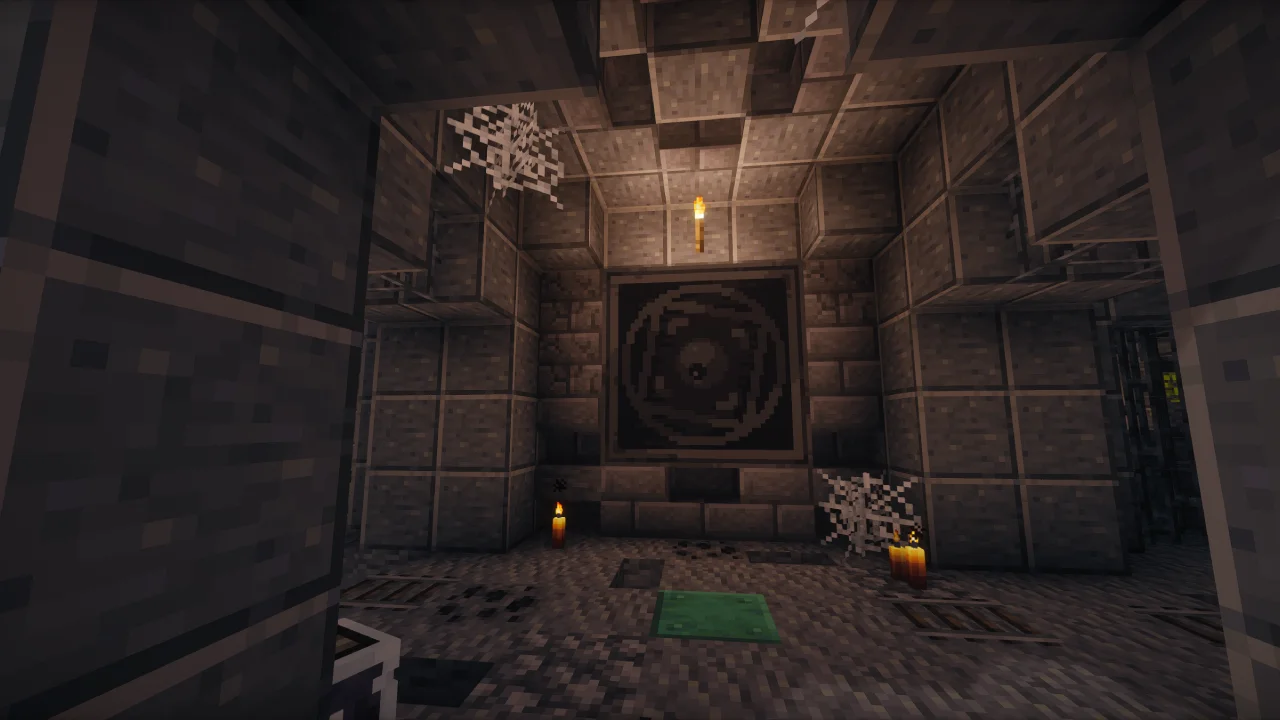
About Terra Restore 2
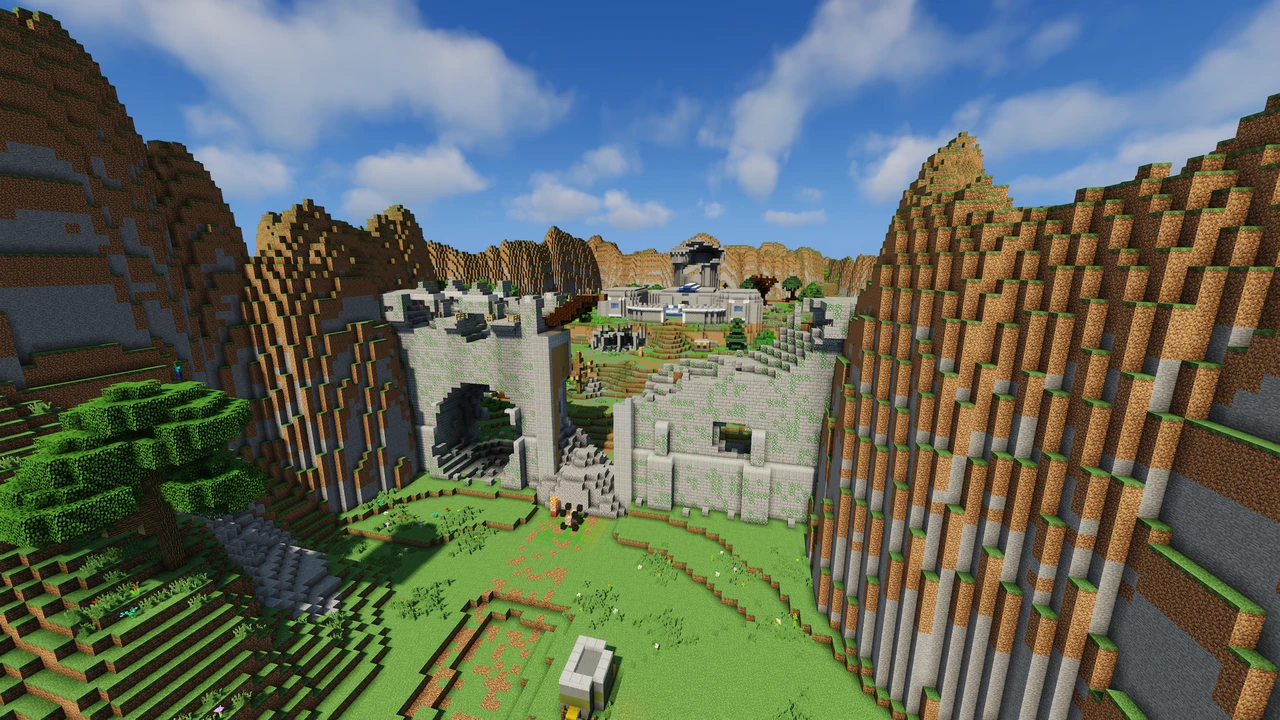
Terra Restore 2 is an adventure map that turns rebuilding the world into its scoring system. You travel Nira alongside Exiel, an enderman companion, clearing dungeon areas and carrying a coloured wool block back from each one. Placing that wool on a monument brings the surrounding land back to life: villagers appear, buildings open, services start working. The map calls each of those blocks a terra restore, and collecting them is both the objective and the way the world opens up around you.
Mithey never finished it. What exists is a substantial alpha that stops partway through a planned sixteen-objective arc, and knowing exactly where it stops is the difference between a good download and a frustrating one.
Restoring the land is the progression
In a conventional Complete the Monument map, the wools are a scoreboard. You fetch them from hostile areas, slot them into a wall, and the wall is the only thing that changes. Here the monument is wired into the world.
Each wool you place transforms the region around it. Areas that were empty gain population; shops and facilities that were shuttered start trading. The consequence is that progress compounds: clearing a dungeon does not just tick a box, it expands what you can do everywhere else. Later regions stay gated behind that progress even though the overworld itself is open to walk through, so the map keeps a sense of direction without corridors.
Alongside it runs a currency called essence, earned from killing monsters and tracked on the scoreboard rather than in your inventory. Essence buys shop goods and upgrades to a central base: an enchanting facility, a kitchen, other rooms with practical uses. Dying costs you some essence and your levels but leaves your inventory alone, which makes death a setback to your economy instead of a wipe.
The official description was frozen at episode one
This is the part worth knowing before you judge the map, and it works in the opposite direction to the usual warning.
Mithey released the map in episodes, and the description on the CurseForge project page still reflects the first of them. It advertises four of sixteen wools and roughly three to six hours of play, and it talks about monthly updates in the future tense. That text was accurate in mid-2015 and was never revised.
The file you actually download is from the third episode. Documentation for that release puts it at nine of the sixteen wools and roughly eleven to fourteen hours, more than double what the project page in front of you claims. So the standard advice of trusting the official listing over the aggregators quietly misfires here. The listing is genuine, it is simply out of date about its own contents.
Where the alpha stops, and what that means
Nine of sixteen planned objectives were built. The remaining seven were never released, and the last file went up in March 2016. Community documentation reports that development was suspended indefinitely. No statement from Mithey setting out reasons has surfaced, and no newer release exists on the official listing.
Unfinished here does not mean broken. The released content is a self-contained run of dungeons, bosses and towns that people have played through end to end. What it lacks is a conclusion: you will reach the edge of what was built and the story will not resolve. Eleven to fourteen hours is a real adventure map by any standard, and it is worth going in expecting that shape rather than a final boss.
An adventure map wearing CTM clothes
The hybrid label is doing real work rather than marketing. Most of the time you are in survival, free to explore the overworld, gather, spend essence and decide where to go next. Towns are safe, hostile spawning is off there, and horses are provided because the distances are genuine.
Then the map takes control. Dungeon challenges and boss encounters switch you into adventure mode, which locks down building and mining for the duration and resets the section if you die. Each dungeon area closes with either a boss or an event (defending an NPC, surviving a set period) rather than simply a chest at the end of a corridor. Challenge rooms in between lean on light parkour, puzzles, timers or waves of enemies.
That switching is the design's whole point. Open-world freedom would make scripted set pieces impossible to stage; permanent adventure mode would kill the exploration. Handing the mode back and forth lets both work, and it is why the map feels different from pure CTM despite sharing the wool objective.
Which version to actually launch
Use Minecraft 1.9 on Java Edition. The v0.3.5 file names that version explicitly and it is the one the release was built against.
You will see 1.8.6 listed against the project, and that tag is real but historical: it belongs to the 2015 alphas, versions 0.1.1 through 0.2.0, before the map moved to 1.9 in early 2016. It is not an alternative way to run the current build.
Nothing needs a mod loader. The map runs on vanilla command blocks and redstone, so a clean 1.9 profile with nothing else in it is both the documented setup and the simplest one to get right. As for newer Minecraft, the honest position is that 1.9 is what is documented and modern versions were never part of the picture. A world from 2016 will often open in a current client, but command-block behaviour has changed across a decade of releases and none of that has been tested here. Several mirror sites tag this map for 1.20, 1.21 and beyond, but those tags come from the host's category system, not from any updated build.
Playing it today
Multiplayer is supported for one to four players, with one or two suggested. Some encounters scale with how many people are present, so a larger group changes the balance rather than simply making it easier. Everyone needs the same copy of the map.
The episode structure left one useful artefact on the download page: a separate save world published alongside version 0.2.0, letting players pick up at the start of episode two without replaying episode one. No equivalent save exists for the 0.3.x line, so a fresh run of the current file starts from the beginning.
The Download section on this page lists every version, the older alphas included, and each row opens Mithey's own CurseForge listing. The map is all rights reserved. Given that the last update was 2016, a mirror advertising a newer version tag is relabelling the same decade-old file rather than offering anything Mithey released.
If the long-form adventure structure is what appeals, Diversity 3 takes a different route through similar territory, and Escape the Lost Halls is a more recent map with a comparable appetite for scripted set pieces.
How to Download Terra Restore 2 for Minecraft
Open the Terra Restore 2 Downloads section on this page and click Download on the v0.3.5 Alpha row, the only one in the 0.3.x line tagged for full 1.9 rather than a 1.9 snapshot. It takes you straight to that file on Mithey's own CurseForge project, where it went up on 11 March 2016 at around 164 MB.
The rows below it are earlier alphas from 2015 built for 1.8.6, kept for archival reasons. They contain less of the map, so there is no reason to pick one unless you specifically want to see how it developed.
How to Install Terra Restore 2 in Minecraft
Make a clean 1.9 profile
In the Minecraft launcher, create a new installation set to 1.9 rather than editing a profile you already use. Launch it once so its folders are generated, then quit.
Keep this profile plain. No mod loader is needed: the map is built on vanilla command blocks and redstone, and Mithey's documented setup is ordinary 1.9. If you normally play modded, a separate installation keeps that setup out of the way rather than risking interference with the map's command systems.
Put the world in saves
Unzip the download and check what comes out before you move anything. The world folder is the one holding level.dat, and that folder is what belongs in your saves directory, not the zip, and not a wrapper folder containing it. Copying the wrong layer is the usual reason a map never appears in the world list.
On Windows that destination is %appdata%\.minecraft\saves. If you gave the 1.9 installation its own game directory, use the saves folder inside that directory instead, because the launcher will not look anywhere else. The guide to installing maps explains why each game directory keeps its own saves folder.
Start the game on the 1.9 profile and the map appears in your singleplayer list. Its resource pack travels with the world, so Minecraft should offer to enable it on first load. Accept it, since the map's audio and visual work depends on it. An in-game book, the traveller's book, holds the map's own options once you are inside, including music preferences.
Notes for a group
One to four people can play, and Mithey suggests one or two. Everyone needs the same version of the map and a matching 1.9 client, whether you host over LAN or on a server. Because some encounters scale with the number of players present, adding people changes the difficulty balance rather than simply splitting the work.
One of those rows is a save world published with version 0.2.0, which starts at episode two of the older 1.8.6 build. Nothing equivalent exists for v0.3.5, so a group starting the current release begins from the opening.